New York City
Bell Atlantic Building
23rd Floor
6th Avenue and 42nd Street
Panel members:
Moderator:
John Lubans
Duke University
I am delighted to be here.
But, it is nevertheless, a bit overwhelming to come from a small place to the big city to share the little I know about the Internet. Especially since what I do know was gathered with less rigor than most serious researchers would tolerate. It all reminds me of something they say on the Pine Ridge reservation in South Dakota.
"An Indian on the Pine Ridge reservation is just another Indian. If he goes off to Nebraska he portrays himself as a local leader. If he makes it to New York, he is a chief. If he gets to Europe, he immediately becomes a shaman." Paris is my next venue!
There are two pieces to my talk. One is a glimpse into how Duke students use the Internet and the other is to propose that we should be exploring ways and means for working together. However uncomfortable collaboration may be for some of us, like my subtitle implies, collaboration may be where the new opportunities are.
First "why" this panel. Why "now"? There are several reasons. For one, there is something compelling about the hypertext proximity between sources and users, between producers and consumers, and especially among sources on the Internet.
But, please keep in mind, the word collaboration does not adequately describe what is happening to conventional ways of doing business, inside and outside organizations. What is clear, I think all of us would agree, is that the Internet is the driver.
|
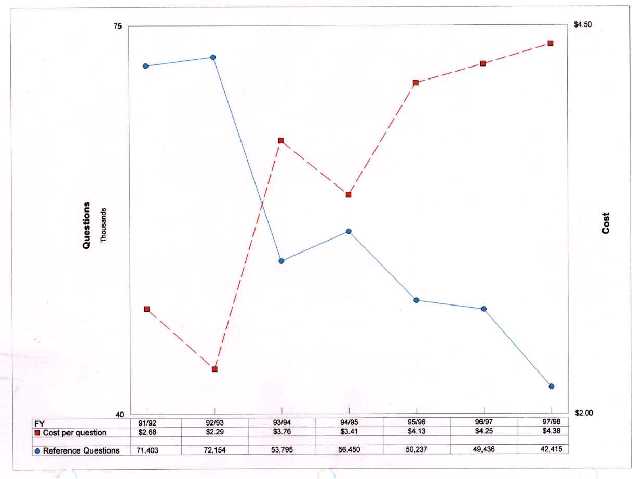
"I can't afford to half my half again".
This year, the Duke trend continued downward, while the cost of answering each question climbed.
I believe this decline parallels new levels of user independence encouraged
by improved interfaces to many electronic reference sources. This is in keeping
with what's been called the YO-YO generation, "You're On Your
Own".
They are the young navigators with a bold streak of independence. Their
mantra:
"It's up to me to create my own well being"
In the same breath, the students tell me they want librarians to be exploring and making the most of the new technology for them. The users see us as expert information navigators, even while they pursue self-sufficiency. I see these seismic shifts in use patterns as opportunities for new roles, rather than our becoming an endangered species.
Anyone using the Internet knows how important the "4th R" has
become.
The "fourth R" is retrieval. That 4th R is not new to many
of us, but as the Internet burgeons in volume and use, retrieval becomes
quintessential - as we all know inefficiency is a surplus on the Internet.
And finally, my introduction to the NYNMA, came by way of an Internet manifesto on Technorealism. I followed that reference to the NYNMA and to Julian Alssid The Technorealists add several reasons to WHY we should be working to leverage the Internet, including:
"We must not confuse the thrill of acquiring or distributing information quickly with the more daunting task of converting it into knowledge and wisdom." or, to put it less elegantly: "It's the content, stupid."
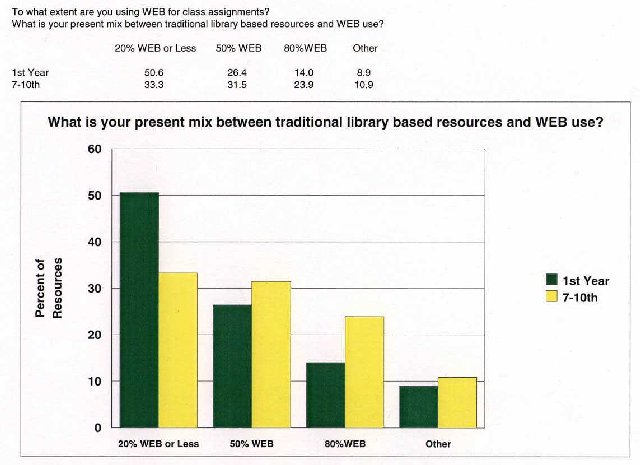
Here are some of the Key Findings from my studies of freshmen and 7-10th graders--I'll call them the "precollege group":
 |
 |
 |
I can see how this leads to claims that:
"the Internet allows users to become their own librarians, able to research
study and investigate anything....
There is a catch, of course. The net ... is causing information overload
Faced with a tidal wave of information, Internet users risk drowning".
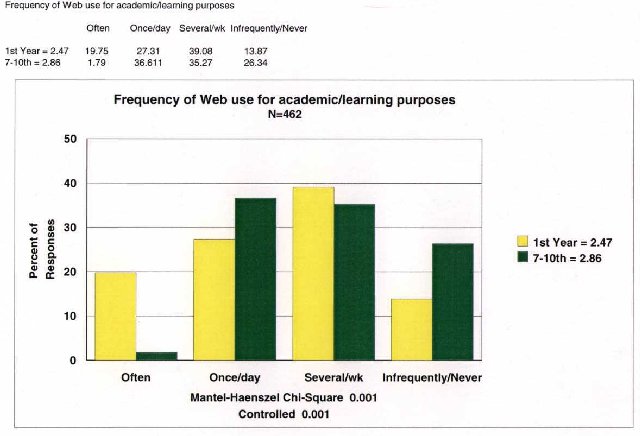
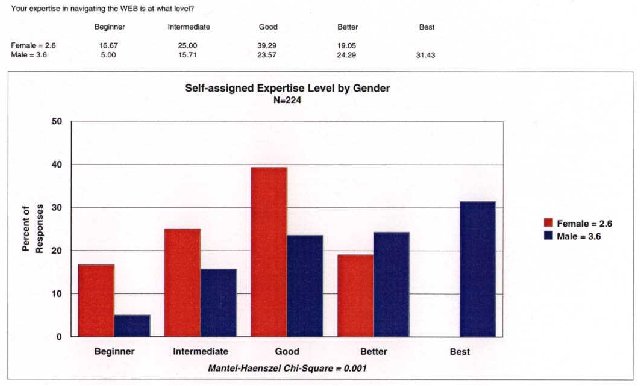
The Web is used for academic/learning purposes not just surfing by a majority of respondents from several times a week to often. However, boys tend to use the Web significantly more often than girls.
As a group, freshmen more often use the Web than do the pre college group.
From the recent report on gender gaps from the
American Association of University
Women comes confirmation:
"girls...rated themselves significantly lower than boys on computer ability...."
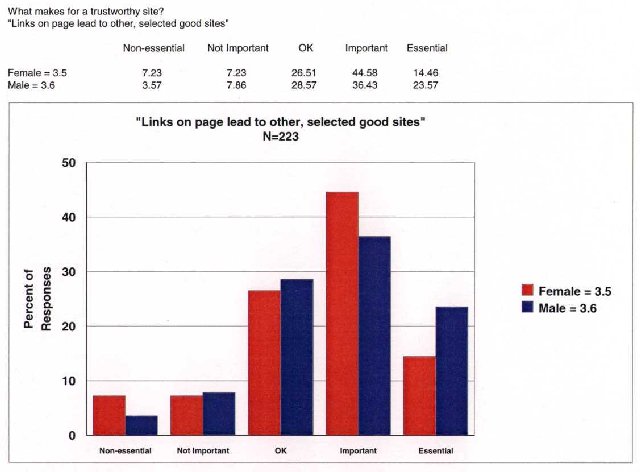
Why the gender gap? Lots to think about there. There is such a thing as a "Female friendly interface"--women like options, according to the Lilly librarians who offered me some opinions on gender issues:
 |
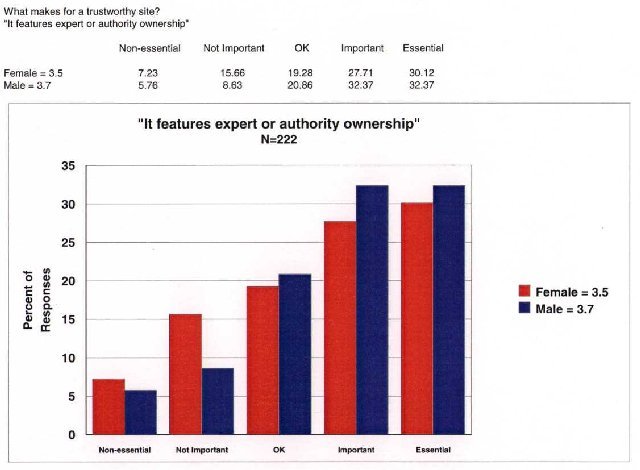 |
When I hear statements like that, I wonder if we are in denial or making an objective and professional observation.
In my surveys,
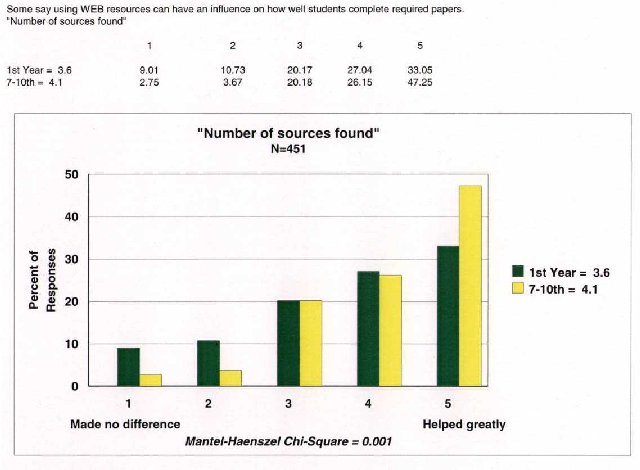 |
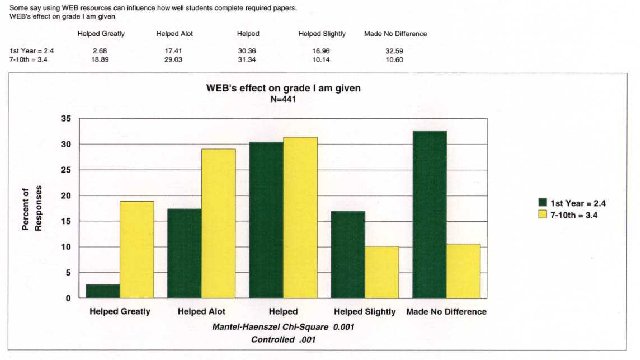
Other significant differences: the pre college group believe their grades for papers are better because of the Web. And similarly, were helped by the Web in the quality of their written work.
My results were more encouraging than the AAUW report which claimed, that
(girls) were less likely than boys to think computers help them do better
on schoolwork.
This group of boys and girls were equal in claiming the Internet helped their
schoolwork.
 |
While both groups have a pragmatic view about the utility of the Internet, the 7-10th graders gave higher ratings to the Internet for accuracy, timeliness, and authoritativeness.
I wonder what Internet skills we should expect graduating high school seniors to have?
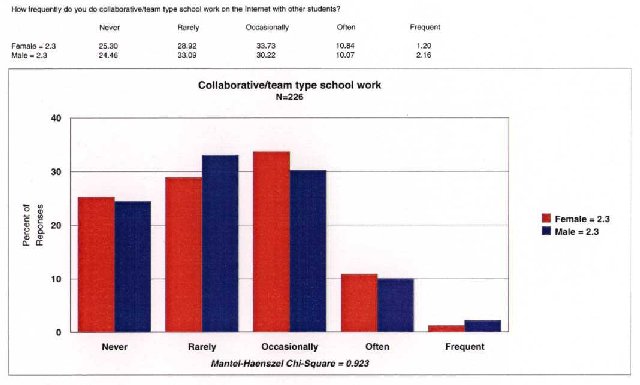 |
Another reality check: a new California survey reveals that among community college faculty members the top uses were exchanging e-mail with colleagues, using the Web to learn more about their disciplines, and requiring their students to use the Internet... Only a few faculty members were doing collaborative work.
Going against this conclusion,
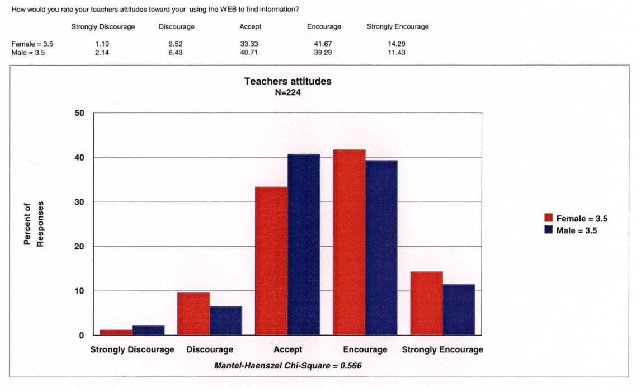 |
I talked with Victor Aluise of WNET earlier today and got some idea of what they are doing at WNET which is quite exciting and supportive of teachers learning about the Internet and helping them introduce it into the classroom in beneficial ways.
 |
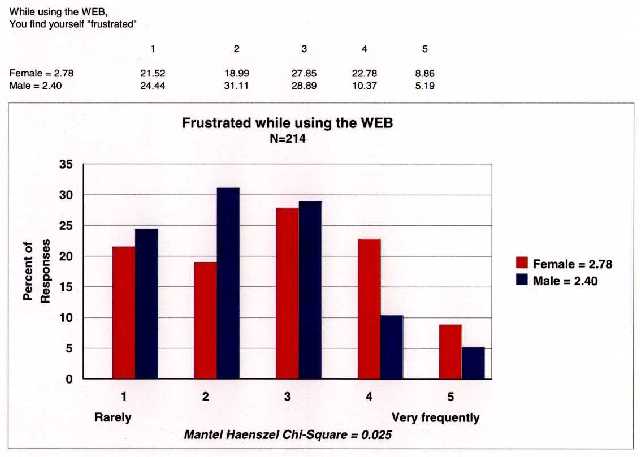 |
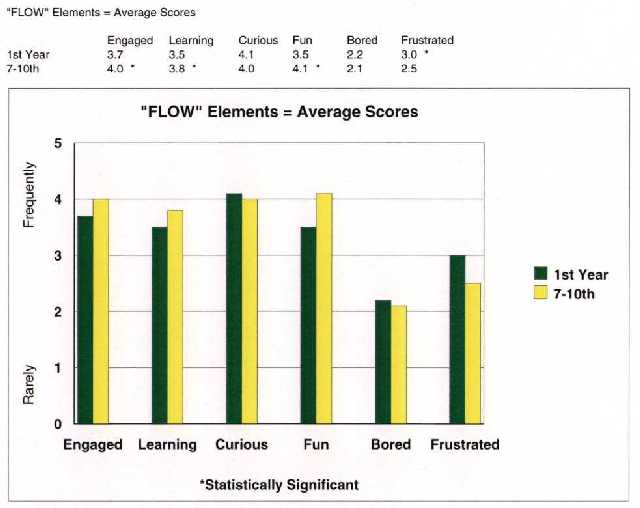
As for being frustrated while using the Web, most students rated this as an infrequent experience, but girls claimed more frustration than boys. Freshmen were more apt to feel frustrated. (Why do you think this is happening?) A colleague thinks this is what happens when students make progress to new levels of complexity.
A majority of students indicate they have fun while using the Web, but the pre college group has significantly more fun than the freshmen.
The above qualities of learning, being frustrated, and having fun when joined by those of being engaged, curious, and bored relate to the Flow concept- a state of being in which one is open to learning because challenges are there enough to arouse interest and yet not too high to promote excessive frustration. The pre college group has a statistically significant greater positive FLOW experience than do the freshmen.
Gender wise, girls wanted classes and one-on-one-tutorials more than the boys did.
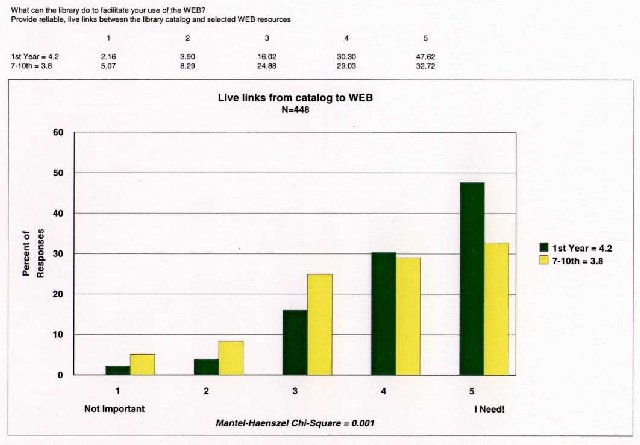
The top two vote getters for how the library can help were: "Develop finding aids (lists of best web sites)"
 |
 |
"Limiting access to only what is owned hurts students".
"One stop shopping" concept a good one.
The provision of hot links from our library catalog to Web sites, intuitively
simple to grasp, could be a first collaborative step. When we know of the
whereabouts of information-rich, durable Web sites and "catalog" these resources
with hot links the relationship changes. The library's relationship to a
cataloged Web site is fundamentally different from that to the books on our
shelves.
Apart from this, students say that if the site is cataloged by the library,
that's equal to a Good Housekeeping Seal of Approval. The immediacy of the
Web changes the publisher/library relationship. Kate Wittenberg's
CIAO, the on-line publication in
International Affairs at Columbia is redefining on-line research publication.
The
freshmen's
focus group was explicit on our cataloging of Web sites:
"LIBRARIES SHOULD BE MAKING INFORMATION SEARCHING MORE EFFICIENT".
How can we enable creative and mutually beneficial collaboration? Besides, as thousands of electronic gadget makers learn each year, "Technology never sells; benefits sell." What benefits can we develop mutually? How do we discover the benefits? It won't happen in a vacuum.
For me, collaboration in cyber space is encouraged because most resources are highly amenable to connection in multiple, yet, unpredictable ways. Exploring juxtapositions may be the best way to find what does work best. There is no road map, "there are only adventures", to quote Berkeley's Web expert
Well then,
How does collaboration work? What does it take?
How can we make it happen?
Collaborations can be characterized as:
There is also something I call pseudo-collaboration ("We Sell/You Buy") - I mention it because it may be the dominant model when not for profits mingle with for profits. This model is "thinking in the box". The "what ifs" that could lead to new services and opportunities, are not considered.
Open approach, "Internet is free", "information wants to be free", while
impractical wishes, may be a succinct way to suggest the attitude that will
help collaboration along,
A recent book on how Netscape gained on Microsoft gives some insights into the collaborative spirit:
Netscape marketed itself as a cross platform company whose products worked equally well on all kinds of operating systems.
"Netscape also leveraged the power of the Internet by giving away early releases of its browser to individual users over the Web. The users offered back suggestions on how to improve the browser, becoming virtual employees of Netscape". Another way to say this: They developed a collaborative relationship with their customers. Collaboration is an Attitude!
For something to happen there has to be a process for inventing collaborations.
Because of the fuzziness around undeveloped ideas, the initial interaction
among stakeholders may be uncomfortable even hostile when it comes to sharing
a potentially new product idea!!!!!? Of greater concern is that the storming
process requires us to suspend judgment and put in abeyance immediate concerns
about "bottom lines".
And our driving tendency to get to a product, to go to next steps, to get to at least an action plan may defeat collaboration. This drive for results can limit us to the pseudo-collaboration model of "I Sell/You Buy".
I was inspired by a visit last year to see the NYPL on line bookstore affiliation with B&N.com. At Duke, the campus Gothic Bookstore and the Perkins Library are now past the formulation or the way-finding stage of collaboration. Our agreed upon goal is straightforward: increased reading and book sales resulting from new services to readers.
The Gothic web site will have links to and from the library and other units
on campus and off. We will test a buy or borrow option for
our library users. Where this collaboration may lead is unclear, but it has
energizing the dozen people involved: librarians, IT people, vendors, Duke
stores staff, bookstore staff.
Linking our inventories and calendars; promoting both borrow and buy!, sharing
and developing communities of readers, all these are exciting ideas.
Ideas for exploration:
Frances Cairncross, in her book The Death of Distance suggests something to keep in mind as we explore collaboration:
"Sellers (when adding value to the same products or service) will compete on convenience, comprehensiveness or quality of service".
This is the Amazon.com model, one well worth looking at for why it is a success.
Alan Bayert will no doubt may speak of the E-blast service from EB. A "what if": What if we load all of EB's 130,000 web links into our on-line catalog?
On and off the campus: there's the pre and post student alumni base. Graduating students are reluctant to give up their e-mail connection. I can see a Duke e-mail account from 7th grade to retirement. Links. Implications?
The AAUW study asks:
"How might technological products advance better - and more equitably - forms
of learning and instruction generally?
I end with a rhetorical question. What do we want to create together?
While you listen to the other members of the panel, envision some collaborative opportunities to share with all of us.
Thank you for listening. I am eager to hear what my colleagues on the panel have to say and then to hear from you!
John Lubans, Jr.
Deputy University Librarian
219 Perkins Library
Duke University
Durham, NC 27708 USA
jl@mail.lib.duke.edu
Phone: 919 660 5800 (work)
Phone: 919 493 4979 (home)
Fax: 919 660 5923
Web:
www.lib.duke.edu/staff/orgnztn/lubans/john.html
Last modified March 11, 1999 by Salana's Very Few Frills Web Design.